


- Written By Team DWS
- Lab-Grown Diamond Jewelry
- August 19, 2026
Understanding the Concept of Lab-Grown Gemstones
The concept of lab-grown gemstones is more complicated than simply saying that such gems are created in laboratories.
The jewellery world is witnessing a significant technological advancement in the development of gemstones such as diamonds and various other gemstones in laboratories. It makes many terms such as lab-grown, laboratory-grown, synthetic and created gemstones very frequent in this industry.
But what does “lab-grown” mean?
The answer is more complicated than the phrase “made in a laboratory.” A true lab-grown gemstone is not merely an attractive piece of colored stone that looks like the natural stone; oftentimes, the gemstone belongs to the same substance as the natural gemstone and all the difference is in the creation method.
Natural gemstones are produced over geological period, as a result of a specific combination of temperature, pressure, chemical composition and environmental conditions. Laboratory methods allow recreating these conditions, and crystals can be produced this way.
This difference is vital for consumers and designers because beauty, identity and transparency are different aspects of the gemstone.
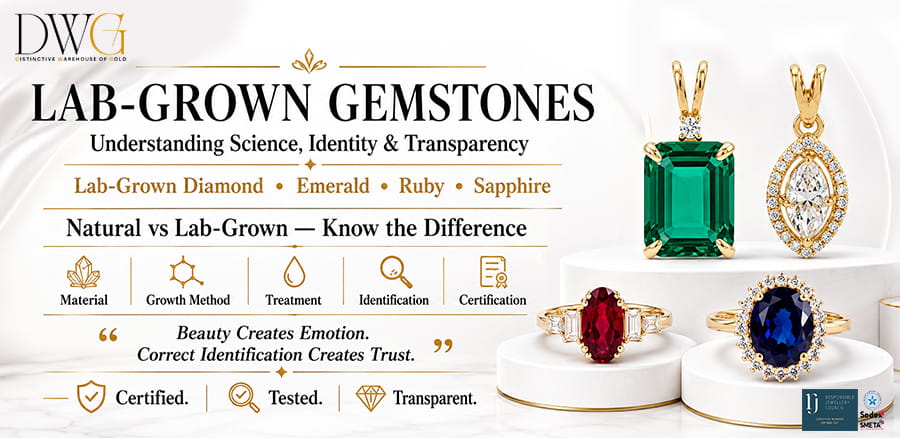
What Is a Lab-Grown Gemstone?
The lab-grown gemstone is the one created through some technological methods instead of through natural geological processes that take place in nature.
The primary aim is not copying. For example:
- Natural diamond consists mainly of carbon, and it is naturally made under the earth surface.
- Lab-made diamond is made of carbon through such processes as chemical vapor deposition or high-pressure high-temperature method.
- Natural emeralds are members of the beryl mineral group.
- Lab-grown emeralds are made in a lab using a process to create beryl with the qualities of an emerald, such as the right chemical and optical characteristics.
- A natural ruby belongs to the corundum family.
- A lab-grown ruby is a lab-created corundum with the properties of a ruby.
- A natural sapphire is a form of corundum colored by the presence of trace substances.
Simply saying that a gemstone is “lab-created” does not provide the right information. The material, structure, method, technique, and identification are essential in this regard.
________________________________________
Natural vs Lab-made: What is the main difference?
Natural vs lab-made gemstones means that the difference may be found in their origin.
Natural gemstones are created as a result of geological processes that can take decades, centuries, etc.
On the other hand, lab-created gemstones are made within the process of making crystal structures.
However, the existence of these different origins doesn’t imply that one type of jewels is considered to be true while the other is regarded as fake.
Thus, the only difference is in the origin of the gemstone.
For instance, we can take diamonds as an example.
There are lab-created diamonds and natural diamonds. Although they are from different origins, it does not mean that they are totally different substances.
It is clear why it is imperative to know the gemstone's identity and its disclosure requirements.
_______________________________________
Lab-made diamond: it is more than just a copy
Lab-made diamonds are probably the most popular gems made in laboratories.
A CVD lab-created diamond is produced using a chemical vapor deposition technique. The process of diamond formation involves heating and vaporization of carbon compounds.
As a result, it ends up being a diamond made of carbon and having a crystal structure from the diamond category.
In contrast, diamond-like materials such as cubic zirconia and glass are similar to diamonds in appearance, but the composition of the materials is completely different.
Yet, this is important to highlight.
A diamond simulant can look the same as a diamond, but it is not a diamond.
Lab-created diamonds are the diamonds developed in laboratories.
This is important for the jewelry producers and marketers as they should let customers know about this.
_______________________________________
Lab-Created Emerald: What Is Beryl?
Emeralds are part of the beryl family.
Natural emeralds are formed in the process of geological development, during which they acquire their green color due to the presence of certain trace elements.
Lab-created emeralds are produced using certain technologies of crystal formation that allow obtaining lab-created beryl with emerald properties.
Thus there is more to the phrase "lab-created emerald" than just "the green stone produced in the lab."
Not every green stone created in laboratories may be referred to as a lab-created emerald.
Some lab-made materials can look like emerald from the outside but be of different materials in fact. Thus, it is very important to understand the importance of accurate identification and transparency.
________________________________________
Lab-created ruby: ruby is a corundum mineral
Interestingly, rubies and sapphires are related in mineralogy.
Indeed, both belong to the corundum family.
Rubies are normally red corundums with their ruby hue being determined by chromium's presence.
Lab-created rubies are obtained by crystallizing corundum under laboratory conditions and incorporating the necessary minerals.
Thus, lab-made rubies belong to the same family of minerals as the natural rubies.
The key distinguishing factor lies in how the gem is created rather than how it looks, as it may still very well be confused for the original gem.
This statement rings especially true for the colored gemstone sector, as consumers have become more educated with their purchases on the subject of colored gemstones.
________________________________________
Lab-Grown Sapphire: Sapphire is also a Corundum Variety
Sapphire is another representative of the corundum family of gemstones.
Although blue sapphire is closely related to the term “sapphire” rubies can be available in different colours as corundum occurs in different shades. Blue coloration usually comes from some mineral residues.
Lab-created sapphires are obtained via crystal growth in a laboratory.
Lab-created sapphires must be correctly identified and disclosed.
Being a jewelry customer, it is essential to know whether sapphire is natural, lab-created or a substitute.
________________________________________
Not All Gemstones Created in Laboratories Are Laboratory-Grown Versions
This may be the major reason one should have before buying or selling colored gemstones.
The fact that a stone-like item was fabricated in a lab does not mean the item is a lab-grown form of a natural gemstone.
It is important to realize that there are a number of items that create the impression of color, luster and appearance of natural stones.
For example, a colored gemstone that is created through a laboratory may completely differ in its chemical composition from an original gem.
Thus, the following concepts should be distinguished:
1. Lab-Made Gemstone
A synthetic gemstone is a stone that has been made in a lab and belongs to the respective category.
2. Synthetic Gemstone
With respect to gemology, “synthetic” means that the material in question was created in a lab and has the same chemical structure as a regular gemstone.
3. Simulant or Imitation
A stone made of different materials than the stone it looks like visually.
Knowing these types of stones is important for responsible disclosure of gemstones used in jewelry.
________________________________________
What Professional testing can tell the following:
- Chemical composition.
- Crystal structure
- Optical properties.
- Inclusions.
- Growth patterns.
- Treatment markers.
- Lab-grown features.
- Natural features.
Different testing techniques must be applied, depending on the type of the gem and what is being investigated.
That’s why authentic identification done by a professional can ensure the value of your purchase.
Certification is Beneficial.
With the help of certification, both manufacturers and consumers can feel relaxed when making jewelery purchases.
A gemological lab is able to analyse a piece of jewellery or gemstone and gather essential information about it.
For lab-created diamond jewellery, a report identifies the diamond as manmade and shares such features as shape, color, clarity, and any other grading information.
In the realm of colored gemstones, laboratory examinations can verify the rarity of the gemstone and determine where it was sourced from.
Certification does not substitute for honesty from sellers but rather complements it.
By combining absolutely correct description of the product with disclosure and independent testing, confidence is being built.
Certification, Testing, and Transparency in the Jewelry World Today
The jewelry sector is progressing toward a situation where clients do not just want high-quality pictures.
They want to get answers to such questions as:
Where does the stone come from?
Is it natural or lab-formed?
What material is that?
Have there been any treatments?
Has it been tested independently?
Is it disclosed correctly?
This is important, especially when it comes to lab-made gems. In order for jewellery makers and brands to be able to make informed choices, they must treat transparency as an integral part of the product. However, when it comes to gemstones, what counts is more than colour and brilliance. Each gemstone is distinguished by its unique identity.
________________________________________
The Consumer Must Be Aware That “Lab-grown” is Just One Way to Describe the Gemstone
When buying jewellery, consumers need to ask several questions:
What type is the gemstone? Laboratory-grown diamonds, emeralds, rubies, sapphires are different materials.
What chemical composition does it have? The information presented makes it possible to distinguish real lab-created gemstones from fake ones.
What technology was used for manufacturing?
There can be various laboratory technologies coming into play to produce different gemstones.
Was the gemstone processed? Certain processes may have happened to some gemstones that may influence their appearance, regardless of whether they were mined or manufactured in a laboratory.
Is there any independent report? In the case of particular pieces of jewelry or types of gemstones, external documentation may serve as evidence.
These simple questions will help to achieve more informed and transparent jewellery market.
________________________________________
Beauty and Truth Hand in Hand
The rise in the popularity of lab-cultured gemstones does not mean that natural stones will lose their significance and attractiveness and, at the same time, both types of stones have their own merits.
Both types of gemstones have their own advantages.
Natural gems speak volumes about the geological past and uniqueness of nature.
Lab-grown gemstones show us human inventions and our ability to create technological environment for producing the materials.
The most important thing is not to confuse the two.On the other hand, if you know what you are purchasing, you are likely to enjoy its true nature.
Laboratory diamonds can be enjoyed as laboratory diamonds.
Natural emeralds can be enjoyed as natural emeralds.
Lab-grown rubies can be appreciated thanks to their color and other properties as a laboratory-grown product.
The value of the gift lies in knowing what it is and not just assuming the name of the gem.
_____________________________
The Future of Lab-grown Gems
Innovation will lead to the advancement of lab-grown gemstones, thus, paving their way to the jewelry industry.
Thanks to the advancements in production technologies, jewelry manufacturers will have even more options when it comes to gem production.
Nevertheless, there will be an increasing necessity for proper gem identification and disclosure.
So, the future of jewelry is not only about the making of gorgeous gems.
It is about creating elegant stones and providing relevant information to the customers in order to let them make the right choices themselves.
_____________________________
Certified. Verified. Transparent.
The jewelry world is a world of trust itself.
Gems may be beautiful, but it is the understanding of the nature of the product that enables customers to have confidence.
That is why the difference Only simply saying “produced in a laboratory” is not enough to describe a lab-grown gemstone. The story it tells depends on the stone itself, its type, and how it was produced.
The chemistry of gemstones—from laboratory-grown diamonds that consist of carbon to lab-grown emeralds which consist of beryl and lab-grown rubies/sapphires which are called corundum family—is fascinating.
It is essential to realize that the origin and the identity represent two completely different things.
Natural gemstones are created by nature in geological processes.
The lab can do the same thing using its controlled methods.
There is no reason to hide the truth.
Truth makes any story more powerful.
It should be noted that informed consumer will demand much more than just beautiful-looking jewelry.
The responsible identification of gemstones and professional testing become important in that respect.
Beautiful gems are not just beautiful, they tell a story just too.
Recognized gemstones have credibility.
________________________________________
Conclusion
Synthetic stones are a significant step forward in the evolution of modern jewelry.
However, there is more than just knowing that they are created in laboratories.
The important questions are what kind of gemstone it is, how was it made, what elements does it consist of, whether the gemstone was treated, how it was reputed, and how it was disclosed.
Lab-grown diamonds are not just imitations of diamonds; lab-created emeralds must not be regarded as the same type as all green stones created in labs, while lab-grown rubies and sapphires are considered to belong to corundum family.
Moving to a jewelry industry where technology and transparency combine is an objective.
When consumers know the origin of the gemstone they are going to buy and what it consists of, they will appreciate it even more because they will know the science behind it.
Certified, transparent, and verified – that’s the future of jewelry innovation.
Popular on Blogs
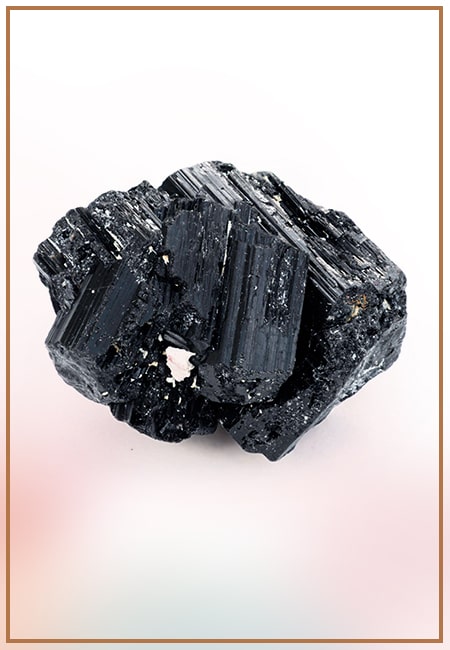
Black Tourmaline: Meaning, Healing Properties, Fascinating Facts, Powerful Attributes, Versatile Uses, and Beyond
September 05, 2023 / BY Team DWS
Black Tourmaline, also known as Schorl, is a highly revered crystal with incredible metaphysical properties. It derives its name from the Dutch word "turamali," meaning "stone with ..
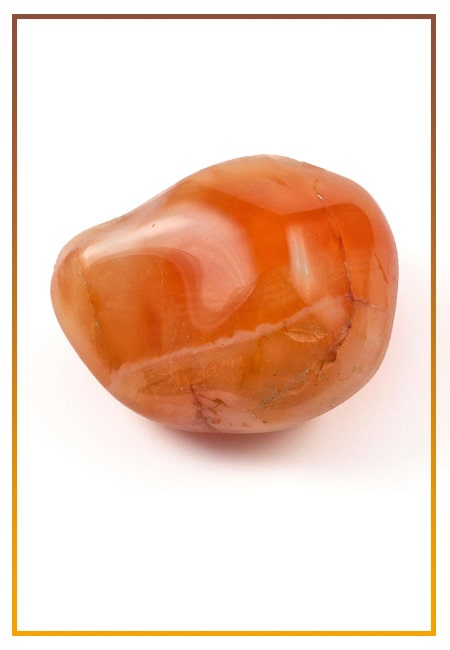
Carnelian Stone: Meaning, Healing Properties, Power, Facts, Color, Uses and More
December 26, 2023 / BY Team DWS
Carnelian is a vibrant and captivating gemstone that holds a plethora of meanings, healing properties, and powers. Its warm and fiery energy makes it a popular choice among crystal ..
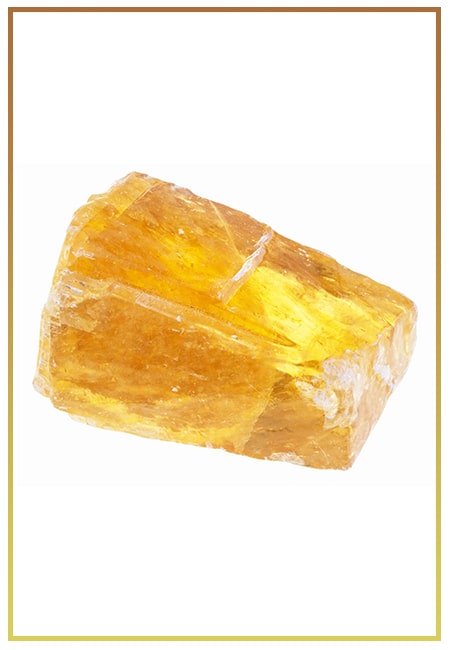
Citrine: Exploring its Meaning, Healing Properties, Fascinating Facts, Powers, Versatile Uses, and Much More
November 18, 2023 / BY Team DWS
Citrine, with its warm golden hues, has captured the attention and imagination of people for centuries. This beautiful gemstone, commonly associated with wealth and prosperity, hol ..
Black Onyx: Unveiling the Meaning, Healing Properties, Fascinating Facts, Powerful Attributes, Versatile Uses, and Beyond
July 25, 2023 / BY Team DWS
Black Onyx, a striking gemstone admired for its deep black hue and elegant appearance, has captivated people for centuries. In this comprehensive guide, we will delve into the mean ..
The History Behind The Popularity of Red Agate
December 23, 2022 / BY Team DWS
An Agate is a type of magma rock that takes many years till it is washed out naturally into the water. And that is the reason this stone has elements of water. This beautiful stone ..
Unveiling the Mysteries of Turquoise Stone: Exploring its Meaning, Healing Properties, Power, Facts, Color, Uses, and More
December 05, 2023 / BY Team DWS
Turquoise, with its captivating blue-green hue, has been adorning jewelry and artifacts for centuries. This striking stone has a rich history, rich symbolism, and a plethora of int ..

Plan a Perfect Valentine's Week with Our Valentine Week List 2026
January 22, 2024 / BY Team DWS
Valentine's Day is undoubtedly the most romantic day of the year, but we believe that one day is just not enough to express your love and make your partner feel special. That's why ..
Taurus Traits: Unveiling the Strengths and Weaknesses of the Bull
January 21, 2025 / BY Team DWS
When considering astrology, the Taurus zodiac sign, represented by the Bull, is characterized by its resilience, practicality, and unwavering resolve. People born between April 20 ..