


- Written By Team DWS
- Festivals
- September 26, 2026
How Is Gold Jewellery Manufactured? A World Smile Day Guide by DWG Jewellery
World Smile Day is a reminder for one and all that it is the small instances of life that contribute to everlasting happiness. A sweet gift, a pleasing design, or a marvellous piece of jewellery can evoke memories quite for a long time to come.
Gold jewellery bears a special relevance due to the preciousness of the material involved (gold), its design and manufacture.
At DWG jewellery, gold jewellery manufacturing consists of a number of steps, all of which are well thought out ahead of time. In this article, we will cover the gold jewellery manufacturing process which consists of a number of stages.
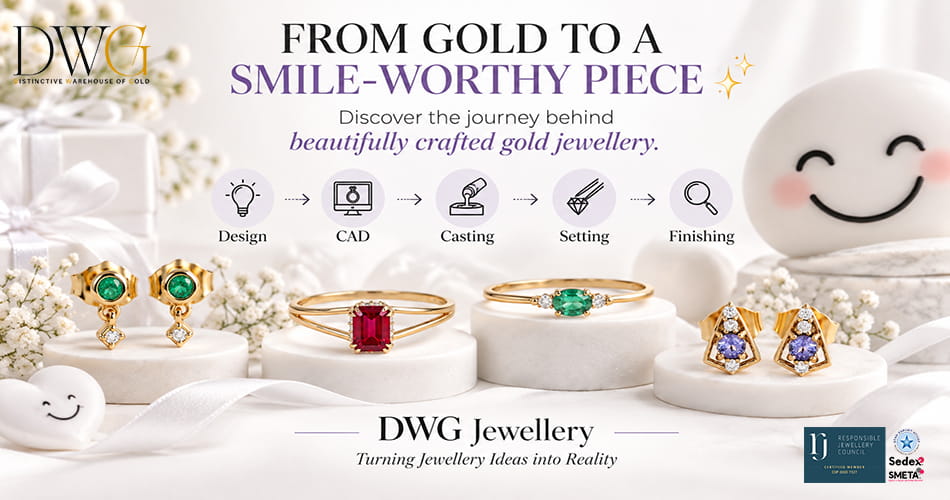
What Is Gold Jewellery Manufacturing?
Gold jewellery manufacturing is the process of turning gold into a particular type of product such as a ring, earring, pendant, bracelet, necklace, or a piece of custom jewellery.
The types of steps performed depend on the design and manufacturing process.
The process may include creation of the following:
- Jewellery design and CAD model
- 3D model
- Wax and resin model
- Casting
- Metal preparation
- Assembly and soldering
- Stone setting
- Polishing and finishing
- Plating when necessary
- Quality control
- Packaging
All those operations will be needed to get the right appearance and durability of the gold jewellery piece.
________________________________________
Step 1: Defining the Jewellry design
Jewellery projects always start with an idea. The design can come from any of the following:
- The brand's idea
- A design sent by a customer
- A borrowed image
- A CAD drawing
- An existing piece of jewelry
- A fully custom requirement
Knowing that the design intention of the brand is very important for the manufacturer, since it influences various aspects of production.
________________________________________
Step 2: Building the CAD Jewelry Model
When the design specifications are final, the concept can be changed into a 3D modeled CAD design.
Computer-aided designing allows the manufacturers to create a complicated representation of jewelry in their digital model.
CAD models can be produced in order to estimate:
- Overall dimensions
- Number of stones and their placement
- Metal thickness
- Settings and structure
- Proportions of the design
- Metal surplus
- Manufacturing difficulty
CAD is especially important in making custom jewelry since it makes amendments at the design stage.
Why Is CAD So Important in Gold Jewelry Production?
A precise model makes it possible to change the idea into a real piece of jewelry and review the design details before manufacturing.
________________________________________
Step 3: Making the Wax or Resin Model
Once the CAD model is agreed upon, a wax or resin model can be produced based on the manufacturing process. This model provides blueprint details and the design of final jewellery. The model plays an integral part in many casts.
________________________________________
Stage 4: Gold Casting
The process of gold creation is the most important part of manufacturing. Golden jewellery is produced via lost-wax (investment) casting. The wax model is covered with casting material. When the preparation stage is finished, the wax gets out of the model leaving a cavity in which molten gold is poured.
Molten gold is poured into the mould.
When the gold is cooled, it is taken out of the mould and cleaned.
What Gold Can be Used to Make Jewelries?
There is a variety of gold purity to manufacture jewelries including:
- 24K gold – the purest and one of softest
- 22K gold – high gold and much more frequently found in certain countries
- 18K gold – one of the most popular types when it comes to fine jewelry,
- 14K gold – known to be widely used in a number of countries
- 9k/10K gold – has less gold but much more alloy metals content
It is true that no certain gold purity is recommended; it all depends on the design, market, customer needs, expected durability, and legislation.
________________________________________
Stage 5: Cleaning and Finishing
After casting, excess metal and sprues need to be eliminated and the casting has to be cleaned. The manufacturing process may include:
- The removal of surplus metal
- Different types of filing
- Grinding
- Edging
- Resolving minor surface defects
- Making the component ready for stone setting
- Bringing the cast closer to its final form
____________________________________________________________
Stage 6: Joining and Soldering
Some types of jewelry designs may involve numerous parts that need to be assembled.
For instance, a necklace or a ring may require different components to be fitted together.
Different types of soldering or any other suitable techniques may be employed depending on the design.
Attention to detail is a must; the components should be in their places but accurately in line with the design.
____________________________________________________________
Stage 7: Setting Gems
If our piece of jewelry contains any gems, then this process will involve their setting.
The following types of setting can be used:
- Prong
- Bezel
- Channel
- Pave
- Flush
- Any other specific type.
The kind of gem setting depends on the gem, design type, appearance, and construction specifics.
Particular attention must be paid to jewelry customization, and both gem dimensions and the setting design are crucial.
____________________________________________________________
Stage 8: Polishing and Finishing
Once the making and setting of gems have been completed, the finished piece needs some signs of finishing.
Depending on the design, jewelry may be polished to different effects:
- High-polished
- Matte
- Brushed
- Textured
- Satin
- Combination.
Polishing is not merely about achieving an attractive shine; various areas of jewelry can be finished differently to create contrast.
____________________________________________________________
Stage 9: Plating and Finishing
Some gold jewelry can be plated or otherwise treated.
There may be reasons for plating but most importantly plating is needed due to numerous factors:
- Base metal
- Purity of gold
- Color
- Thickness
- Application
- Customer needs.
The consistent quality of both finishing and plating processes is important, especially for jewelry with several brands.
____________________________________________________________
Stage 10: Quality Control
One of the main aspects of jewelry production.
The manufacturer will make quality inspections and will pay attention to:
- Dimensions
- Weight
- Surface quality
- Placement of stones
- Setting
- Soldering and joining
- Quality of polishing
____________________________________________________________
Stage 11: Final Steps
After the finish of manufacturing and quality checks, the piece is prepared for shipment, which involves:
- Cleaning
- Inspection of products
- Tagging
- Packing
- Documenting
- Verifying orders
- Preparing for shipment.
________________________________________
What is Different about Custom Gold Jewellery Manufacturing?
The manufacturing of custom jewellery is distinguished from the production of standard catalog offerings by the fact that the product is created as per particular specifications.
A custom project usually entails changing:
Design → Size → Gold purity → Gemstones → Setting → Finish → Quantity → Packaging
Thus, communication between the manufacturer and the jewellery brand is paramount.
The best manufacturing partner should possess the ability to comprehend the design concept and implement it into a practical production process.
_____________________________________________________
Gold Jewellery Manufacturing for Jewellery Brands
For jewellery brands, production means much more than just creating a finished item.
The appropriate production process can help a brand in:
Design Development
Transforming ideas into production-ready jewellery pieces
Customization
Making adjustments to the designs to meet the specific needs of a client or brand
Factor of Consistency
Consistent quality across different batches of items produced
Scalability
Ability to meet production volume demands of businesses
Quality Control
Ensuring the quality of items throughout all stages of production
Communication
Providing specifications for the production process and ensuring the right communication
_____________________________________________________
How DWG Jewellery Approaches Gold Jewellery Manufacturing
At the DWG jewellery company, the entire process of gold jewellery manufacturing can be viewed as a meeting of design, craftsmanship, technology, and quality control. The method consists of:
Design Concept→CAD→Model→Casting→Finishing→Stone Setting→Polishing→Quality Control→Finished Jewelry
Knowing this process can help jewelry brands that aim for custom manufacturing to better explain their product requirements and create designs that are easier to produce.
________________________________________
Why Gold Jewelry is a Meaningful World Smile Day Gift
World Smile Day serves to recognize smiles and spread happiness.
Gold jewelry gives a personal meaning to this occasion due to its symbolic significance:
- Appreciation
- Friendship
- Love
- Success
- Celebration
- Personal milestones
- Memorable moments
A piece of jewelry that has been chosen with care may turn into a piece of art that carries special meaning rather than just a decoration.
________________________________________
From an Idea to A Piece of Jewelry That Causes Smile
Creating a finished piece of gold jewelry requires creative ideas, good design, workmanship, and thorough inspection.
Next time you see a gold ring or a pendant, keep in mind that this object has gone through various processes before reaching the end customer. On this World Smile Day, DWG Jewellery highlights the various people, thoughts, and skills involved in the creation of jewellery, which most of the time becomes a part of the most unforgettable moments in life.
Sometimes a wonderful piece of jewellery is made not only of precious metal, but it is also created with a view of being incorporated into a story.
________________________________________
Answers to the Most Frequently Asked Questions about Gold Jewellery Production
1. What is the first stage of creating gold jewellery?
The process starts with studying the requirements related to jewellery design and manufacture, and CAD is used for the production of designs that require digital modeling.
2. What is the process of casting gold jewellery?
In the process of lost-wax method, wax or resin model is used and then melted gold is poured into a mold after it is prepared.
3. Can gold jewellery be personalized?
Yes. Customized gold jewellery is created in accordance with different requirements such as design, dimensions, gold purity, gemstones, settings, finishing, and quantity.
4. What is CAD in jewellery manufacture?
CAD refers to computer-aided design which is used to produce a detailed digital three-dimensional model of a piece of jewellery before actual manufacture.
5. Does every piece of gold jewellery require casting?
No. The methods employed depend on the jewellery design and its requirements in course of production regarding design and method of manufacture.
6. What takes place after gold jewellery is cast?
Cleaning, assembling, refining, stone-setting, polishing, finishing, inspecting, and preparing for delivery is what happens next depending on the design of the jewellery pieces.
7. Why is quality control so crucial in jewellery production?
Quality control is used in order to ensure that the final jewellery product meets all the requirements including design, dimensions, stones settings, finishing, etc.
8. Do jewellery manufacturers produce gold jewellery in bulk?
Yes. Manufacturers of jewellery may produce a number of pieces for jewellery brands and wholesale clients based on their capabilities and demand of orders.
________________________________________
Final remarks
Gold jewellery manufacture is the process of merging arts and technologies with craftsmanship. At the time of the production of jewellery the very first idea becomes a finished and used piece of jewellery.
On the one hand, DWG Jewellery supports the fact that jewellery is produced for the purpose of incorporating it into memorable moments and the process of production is of great significance.
Popular on Blogs
Black Tourmaline: Meaning, Healing Properties, Fascinating Facts, Powerful Attributes, Versatile Uses, and Beyond
September 05, 2023 / BY Team DWS
Black Tourmaline, also known as Schorl, is a highly revered crystal with incredible metaphysical properties. It derives its name from the Dutch word "turamali," meaning "stone with ..
Carnelian Stone: Meaning, Healing Properties, Power, Facts, Color, Uses and More
December 26, 2023 / BY Team DWS
Carnelian is a vibrant and captivating gemstone that holds a plethora of meanings, healing properties, and powers. Its warm and fiery energy makes it a popular choice among crystal ..
Citrine: Exploring its Meaning, Healing Properties, Fascinating Facts, Powers, Versatile Uses, and Much More
November 18, 2023 / BY Team DWS
Citrine, with its warm golden hues, has captured the attention and imagination of people for centuries. This beautiful gemstone, commonly associated with wealth and prosperity, hol ..
Black Onyx: Unveiling the Meaning, Healing Properties, Fascinating Facts, Powerful Attributes, Versatile Uses, and Beyond
July 25, 2023 / BY Team DWS
Black Onyx, a striking gemstone admired for its deep black hue and elegant appearance, has captivated people for centuries. In this comprehensive guide, we will delve into the mean ..
The History Behind The Popularity of Red Agate
December 23, 2022 / BY Team DWS
An Agate is a type of magma rock that takes many years till it is washed out naturally into the water. And that is the reason this stone has elements of water. This beautiful stone ..
Taurus Traits: Unveiling the Strengths and Weaknesses of the Bull
January 21, 2025 / BY Team DWS
When considering astrology, the Taurus zodiac sign, represented by the Bull, is characterized by its resilience, practicality, and unwavering resolve. People born between April 20 ..
Unveiling the Mysteries of Turquoise Stone: Exploring its Meaning, Healing Properties, Power, Facts, Color, Uses, and More
December 05, 2023 / BY Team DWS
Turquoise, with its captivating blue-green hue, has been adorning jewelry and artifacts for centuries. This striking stone has a rich history, rich symbolism, and a plethora of int ..

Plan a Perfect Valentine's Week with Our Valentine Week List 2026
January 22, 2024 / BY Team DWS
Valentine's Day is undoubtedly the most romantic day of the year, but we believe that one day is just not enough to express your love and make your partner feel special. That's why ..