


- Written By Team DWS
- Gemstones
- March 30, 2026
A Complete Guide to Diamond Varieties and Their Unique Sparkle
Not only are diamonds beautiful and rare; they are also a symbol of everlasting, unending perfection, and a symbol for love and authority. Each type of diamond tells the nature story of Mother Earth creating something beautiful, as well as revealing the beauty of man-made craftsmanship, exactly the same way all other types of gems do. Understanding the different types of diamonds will enhance a jewelry collector's appreciation for fine jewelry and also help a bride-to-be know what type of diamonds she wants to wear on her wedding day while also benefiting a gem lover by teaching them more about how to look for the living quality in diamonds.
This guide will provide a thorough overview of all of the various types of diamonds available on the market today, including the diamond's origin; the characteristics that make each type of diamond unique; and the way each type of diamond responds to light. This article will also look at objective and subjective diamond value. The main focus will be on three characteristics (color, cut, and clarity), that are used to assess a diamond and the way they together form the overall diamond value; as well, how to select a diamond based on an individual’s own style, budget, and taste.
1. The Allure of Diamonds: Nature’s Masterpiece
For billions of years, diamonds have been created by high temperatures and high pressures deep within the Earth and changed from raw carbon crystals to exquisite gems.
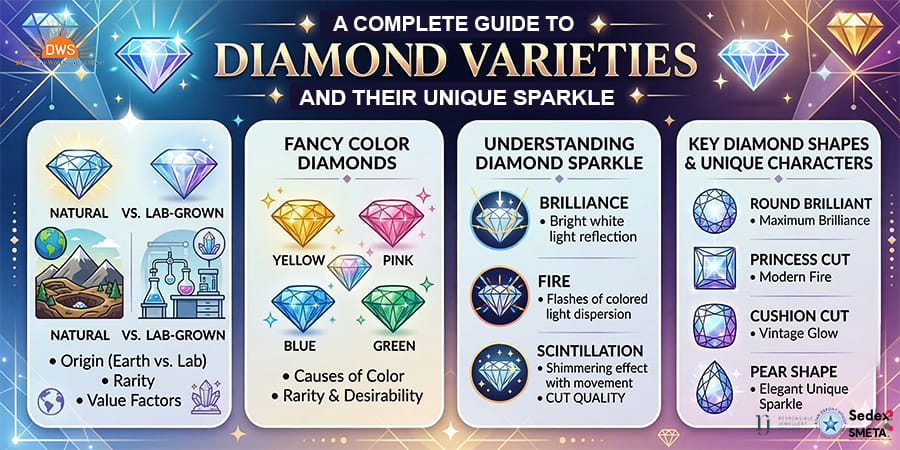
When light strikes a diamond, it creates a dazzling spectacle as the diamond comes to life and sparkles brightly. If cut well, diamonds will be dazzlingly bright (brilliance occur), the light is refracted (fire occur), as well as the scintillation occur as the light passes through the stone.
The appearance of diamonds is amazing and can change color and shape (for example: colorless is cool, champagne is warm).
_______________________________________
2. The Two Main Categories: Natural vs. Lab-Grown Diamonds
In comparing diamond types, there are two main types of diamonds to recognize:
- Diamonds that occur in nature form through many years of changing temperatures and earth pressures.
- Diamonds made in laboratories will use either a high-pressure high-temperature process or a chemical vapor deposition process for creating diamond crystals in a controlled environment. They have the same optical, chemical, and physical characteristics as naturally occurring ones; however, they cost 30-50% less because there are no external mining and sourcing expenses included in the cost of an artificially created diamond versus a naturally created diamond.
Historically and emotionally, a naturally-occurring diamond is a part of you. However, an artificially-produced (manufactured rather than naturally-occurring) diamond provides you with the chance to buy an item that has many of the same characteristics as a natural diamond and does not cause any negative impact on the environment.
________________________________________
3. The Classic White Diamond: The Representation of Purity
The first thing most people think about when they imagine a diamond is the classic white or colorless diamond. White Diamonds can be graded using the GIA Scale from D (the highest grade) all the way to Z (the lowest grade), and they will remain a classic, versatile diamond forever.
- Diamonds in the D-F range are colorless and consequently the rarest and most valuable; they offer the most pristine clarity and icy sparkles of light.
- Diamonds from G-J have high brilliance but are less expensive than diamonds from D-F; when viewed through a loupe, they appear somewhat warm.
- Diamonds from K-M are considered to be faintly colored and tend to have a warm character. They are often seen in vintage or yellow gold necklaces because of this characteristic.
Diamonds with Cuts That Provide Sparkle:
The most sought-after diamond cut is the round brilliant cut; because this cut can return, or reflect, the greatest amount of light through it return of light with 58 facets whose angles are precisely cut. Other diamond cuts, such as princess cuts, cushion cuts, or oval cuts provide excellent sparkle and brilliance to colorless diamonds.
________________________________________
4. Fancy Color Diamonds: Nature’s Rare Art
There is so much more than just clear diamonds! Fancy colour diamonds come in a variety of hues, including blue, pink, yellow, green, and black. Many of these fancy colour diamonds are coloured due to some type of trace element present in the crystal, as well as irregularities that occurred during the diamond's formation.
4.1 Yellow Diamonds
Canary diamonds are yellow diamonds that get their color from the presence of nitrogen atoms in the diamond crystal structure. Canary diamonds range in color from bright red/orange to pale champagne yellow.
Perhaps the most well-known example of a canary diamond is The Yellow Diamond, a stunning 128-carat diamond.
Canary diamonds look stunning when set in white or rose gold settings because these metals enhance the natural warmth of the canary diamond.
4.2 Pink Diamonds
The Argyle mine is home to the majority of the world’s very rare pink diamonds. The formation of pink diamonds is influenced by geological pressures during the creation process, which result in unique distortions and a pink coloration ranging from soft to highly saturated (vivid).
The Pink Star Diamond (59.60 carats) is the highest price paid for a diamond at auction.
Pink diamonds represent true Romance, Creative spirit, elegance.
4.3 Blue Diamonds
Trace levels of boron give these gems their captivating ocean blue color. These gems are extremely rare and sought after by collectors.
- Example: The Hope Diamond: Is surrounded by many myths and has a deep blue color.
- Style Tip: Blue diamonds work well with platinum and white gold jewelry.
4.4 Green Diamonds
Green diamonds are truly unique creations of nature. They obtain their green hue due to the very prolonged process of exposure to radioactive radiation. Originally discovered in geological deposits millions and even billions years old, green diamond color ranges from mint (very pale green) to deep forest (very dark green).
- One of the most famous green diamonds is the Dresden Green Diamond.
- Green diamonds are very rare and are sometimes found with colored patches or "color-zoned."
4.5 Black Diamonds
Strong, unique types of diamonds known as black diamonds (or carbonados) are rare; they are black because of the presence of graphite impurities. The increasing popularity of contemporary jewelry design has led to a greater interest in these unusual and beautiful gemstones.
- Designers like these diamonds for their contrasting characteristics as well as their interesting textures.
- A black diamond represents strength, character, individuality, and desire.
4.6 Brown, Champagne & Cognac Diamonds
Prior to recent times, brown diamonds were deemed to be of lower value than other color diamonds; however, with the advent of a new fashion for these stones, known as "champagne" or "cognac," their price has increased substantially because of their perceived warmth and versatility.
- Mostly mined at: Argyle Mine, Australia.
- Use for: Bohemian style; vintage-style; artistic-style.
4.7 Rare and Exotic Colors
The most rare colored diamonds found on Earth are diamonds called red, orange or purple! There are very few red-colored diamonds so they usually command the highest price per carat of the three colors mentioned above.
________________________________________
5. Fancy Cuts of Diamonds: Creating a Glimmering Effect
The structure or shape that creates a diamond's sparkle is called its "cut." The diamond's cut includes its overall shape, proportions, symmetry and how the facets interact with each other. Each of these design factors has an impact on the light that passes through the diamond and causes it to refract, thereby creating maximum brilliance or some amount of backlash.
There are 8 main types of diamond cuts that create unique looking diamonds with unique qualities of sparkle.
- Because of its symmetry and proportions, the round brilliant cut creates the highest amount of brilliance of all types of diamond cuts, thus making it the perfect diamond for an engagement ring.
- The princess cut has more sparkle than any other type of diamond cut and offers both contemporary and retro design styles.
- The drawback of a cushion cut is that it has large flat facets that can move light through it; therefore, they will not have as much sparkle as traditional vintage style diamonds are able to do.
- The Emerald cut (step-cut) produces a diamond with nice depth, yet produces very little sparkle because of the way light passes through it.
- The oval cut produces overall similar sparkle to a round cut diamond and provides an extremely elegant extended finger effect.
- The marquise shape has the maximum surface area of all diamonds that creates an extremely large looking diamond for the amount of carats used.
- The pear shape is similar to a combination of a round cut and a marquise cut and creates an extremely elegant and dramatic look.
- The heart shape is very similar to a traditional round diamond in that they produce maximum brilliance and sparkle however they are very romantic and used in heart pendants or given as gifts of love typically as anniversary gifts.
Each cut uses light differently; therefore while round diamonds produce the most brilliance of all diamond cuts, all step-cut and fancy diamond cuts exhibit elegance and originality.
________________________________________
6. Diamond Clarity: The Inner World of a Gem
The GIA (Gemological Institute of America) defines clarity as the presence of any internal or external features that can impact the look of a diamond, and if a diamond has no internal features and only a few minor external features, then it is classified as "clarity" or "clean" (that is to say: no color, spots or other inclusions).
Diamonds are graded using a 5-graded clarity system by the GIA, ranging from Flawless (FL), being the best diamond available, to Included (I3), being the worst quality of diamond available.
- FL and IF diamonds are the rarest and most valuable.
- VVS (1-2) diamonds have some very minute inclusions that are only detectable with 10x magnification.
- VS (1-2) diamonds have small inclusions or other characteristics that are only visible upon close inspection and represent good value for the price.
- SI (1-2) diamonds have slight inclusions visible with magnification but are typically not visible to the naked eye.
- I (1-3) diamonds have noticeable inclusions affecting the transparency of the diamond and may also affect its brilliance.
Tip: Most consumers looking for the best combination of beauty, value and price will find that diamonds with clarity ratings between VS and SI are an excellent choice
______________________________________
7. Carat Weight: Size and Presence
Carat weight is used to determine the weight of a diamond, or the “size” — carat weight and visual size are often related but not always the same thing; one carat = 0.2 grams; as carat weight increases, so does natural rarity and value at an exponential rate.
But, two diamonds that are equal by carat weight may have different visual size due to cut proportions. A diamond that is cut well, or ideally, will sparkle much more brightly than a diamond that is cut poorly (therefore less visually appealing), even if the first diamond is smaller than the last because it has gained a significant amount of weight through hidden facets.
Example: A round brilliant diamond that has an ideal cut and weighs 1.0 ct will appear to be larger than a diamond that is 1.2 ct but cut too deep, which means it has a portion of its weight that is hidden inside the stone.
________________________________________
8. Rare Diamond Types and Phenomena
Some diamonds have very interesting effects that make them distinct and sought after as improve:
- Fluorescent Diamonds: Will fluoresce blue or green under an ultra-violet light making them more captivating
- Salt and Pepper Diamonds: Have many inclusions that appear as a galaxy of stars - perfect for bohemian style jewels.
- Treated or Irradiated Diamonds: Made brighter or darker by man.
- Chameleon Diamonds: These are incredibly rare and change color based on the heat from a hand or upon exposure to any light source.
Every one of these amazing characteristics have revealed to us that along with all things imperfect, in nature, diamonds contain their own uniqueness enhancing their beauty as well.
________________________________________
9. Different Types of Diamonds Are Used To Create Different Types of Jewelry Designs
Designers use many different types of diamonds in their jewelry designs to create contrasting designs, symbolise and use creativity.
For example:
- White diamonds will be appropriate options in timeless solitary designs, wedding rings and with heirloom pieces
- Yellow diamonds could be incorporated into halo or floral designs creating a brilliantly colourful piece of jewellery such as a statement ring.
- Black diamonds are an ideal option to give a masculine ring, bracelet, or contemporary style earrings added boldness and assurance of character.
- Rose gold champagne diamonds will give an attractive romantic vintage look to a piece of jewellery giving it an old world charm.
- For example, a pink diamond can enhance the feminine and luxurious style of an engagement or pendant/necklace.
- Blue diamonds will represent modern royalty and are one of the best choices available to have custom manufactured, fine quality, high-end jewellery.
Sometimes, gemologists will use two or more different types of diamonds when designing a high-end piece of jewellery; for example, white diamond as a centre stone with different colour diamonds surrounding it will allow the overall design to appear deeper and more richly textured than the centre alone would be.
________________________________________
10. Ethical and Sustainable Diamond Choices
More consumers today are looking to purchase ethically sourced products and be educated about sustainability. Diamonds created in nature and in laboratories can both be considered responsibly sourced if they have come from an ethical supplier with appropriate certification and transparency associated with their production.
- You can validate the ethical sourcing of your natural diamond by requesting a Kimberley Process Certification. This is clear evidence that your diamond has not been sourced from any conflict area.
- Your laboratory created diamonds will have gone through a third-party laboratory like GIA, IGI, or HRD to ensure their authenticity and quality.
- Laboratory created diamonds are an ideal choice for consumers wanting to make eco-friendly choices while spending less than they would on natural diamonds.
DWS Jewellery sources their diamonds and can trace their origins to provide the highest standard of ethical diamond production. Hence, every DWS Jewellery diamond reflects on the diamond itself in terms of beauty and workmanship.
________________________________________
11. Choosing the Right Diamond for You
The ideal diamond for you will not just fit the 4 C's (Carat, Color, Clarity, and Cut), but will also reflect your sense of style, its intended use, and how you feel about it.
Here is how to balance the different aspects of diamonds so that you find a piece that is both perfect for you and a good value.
- For the most sparkle: Look for a Round Brilliant Cut with G-H Color and VS Clarity.
- You might want to use unusual coloured or salt-and-pepper diamonds so that you can show your individual taste.
- For luxuriousness on a budget: Select near colorless diamonds (G-J) or lab created diamonds.
- For long-term value: Rare color diamonds like pink and blue will maintain their value over time.
Just as the most brilliant diamond is not necessarily the most costly, the one that has the closest representation of who you truly are will serve as a perpetual reminder of your special time together.
________________________________________
12. Diamond Care and Maintenance Tips
The hardest natural resource known to mankind is diamond, but even though they are very tough, they also must be handled gently to maintain their beauty.
- To keep your diamond looking great, you should regularly clean it with warm water, mild soap, and a soft toothbrush to remove dirt or oil that might build up.
- Do not use abrasive cleaning products (like bleach or strong detergents) or anything else that could damage the stone's value.
- Inspect the prongs and clasps of the setting to make sure they are still secure and will not allow a diamond to fall out.
- Have your diamond being cleaned and inspected by a professional at least once per year.
- When storing your diamond, use soft pouches or lined boxes so that your diamond does not get scratched by another stone that has been stored with it.
By following these simple tips, you can keep your diamond as beautiful as on the day that it was cut.
________________________________________
13. The Future of Variations of Diamonds in Design
As consumers' desires shift, this range of various types of style allows jewellers to express their creativity in many ways. Designers are now using innovative techniques of combining the usage of colour and shape and employing design thinking in new and unique ways. An example of this would be: taking a white diamond and pairing it with a coloured diamond. Many designers showcase resourceful ways of using contrast colour or sustainable materials to create new designs by using unrefined gemstones.
Imitation or lab-created coloured diamonds offer a wide range of creative possibilities on a very accessible price point, whilst naturally formed fancy coloured diamonds remain a symbol of wealth and as a desired investment grade item. The global jewellery industry has shifted towards expressing yourself as an art form rather than just as luxury goods by providing individuals with multiple varieties of diamonds to choose from.
The diamond trade has never been stronger than it is now by being positioned at the crossroads of tradition, technology and transparency of experiencing a new phase of growth for excellence in jewellery.
Conclusion
Diamonds are a type of gemstone that can be used to create many looks, either by shining like a colourless diamond, or they can create an extraordinary number of colours and ways to shine through fancy coloured diamonds.
Each diamond holds its own distinct history and is made up of various elements from the earth and combined with the work of the hands of man.
Understanding this will help you select the type of diamond for your needs, whether you want to create an engagement ring, a custom piece of jewellery, or to give an heirloom from one generation to another.
The next time you look at a diamond, don't just think of what you see; think of everything that has been done in order to achieve that sparkle and the history behind it.
Popular on Blogs
Black Tourmaline: Meaning, Healing Properties, Fascinating Facts, Powerful Attributes, Versatile Uses, and Beyond
September 05, 2023 / BY Team DWS
Black Tourmaline, also known as Schorl, is a highly revered crystal with incredible metaphysical properties. It derives its name from the Dutch word "turamali," meaning "stone with ..
Carnelian Stone: Meaning, Healing Properties, Power, Facts, Color, Uses and More
December 26, 2023 / BY Team DWS
Carnelian is a vibrant and captivating gemstone that holds a plethora of meanings, healing properties, and powers. Its warm and fiery energy makes it a popular choice among crystal ..
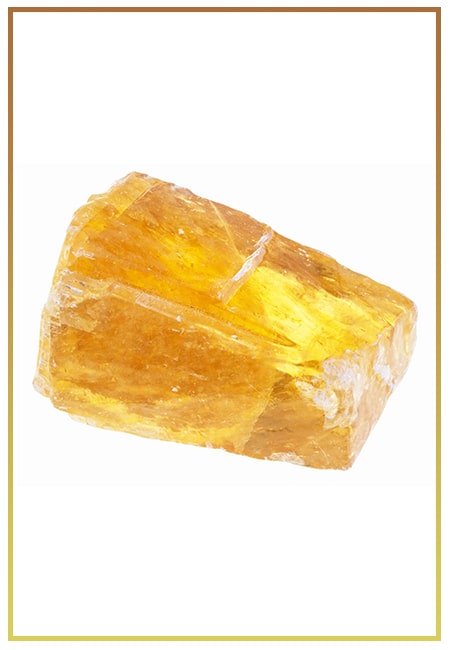
Citrine: Exploring its Meaning, Healing Properties, Fascinating Facts, Powers, Versatile Uses, and Much More
November 18, 2023 / BY Team DWS
Citrine, with its warm golden hues, has captured the attention and imagination of people for centuries. This beautiful gemstone, commonly associated with wealth and prosperity, hol ..
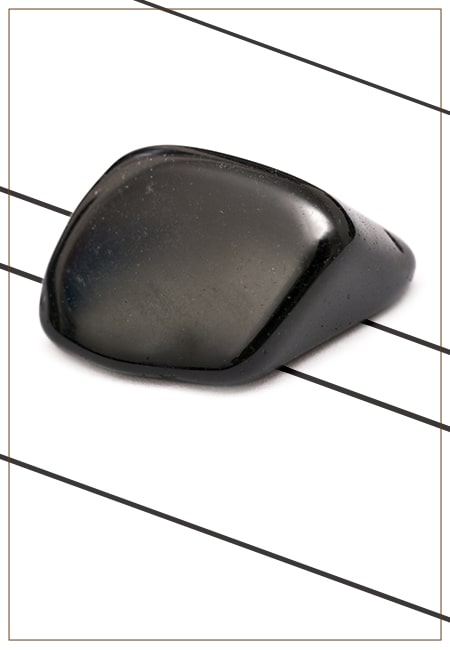
Black Onyx: Unveiling the Meaning, Healing Properties, Fascinating Facts, Powerful Attributes, Versatile Uses, and Beyond
July 25, 2023 / BY Team DWS
Black Onyx, a striking gemstone admired for its deep black hue and elegant appearance, has captivated people for centuries. In this comprehensive guide, we will delve into the mean ..
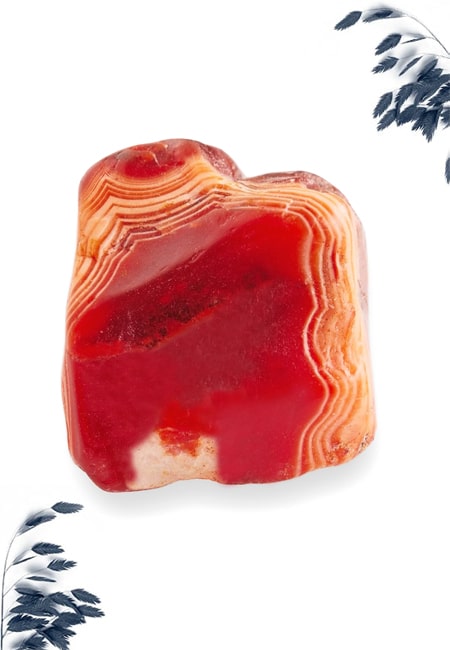
The History Behind The Popularity of Red Agate
December 23, 2022 / BY Team DWS
An Agate is a type of magma rock that takes many years till it is washed out naturally into the water. And that is the reason this stone has elements of water. This beautiful stone ..
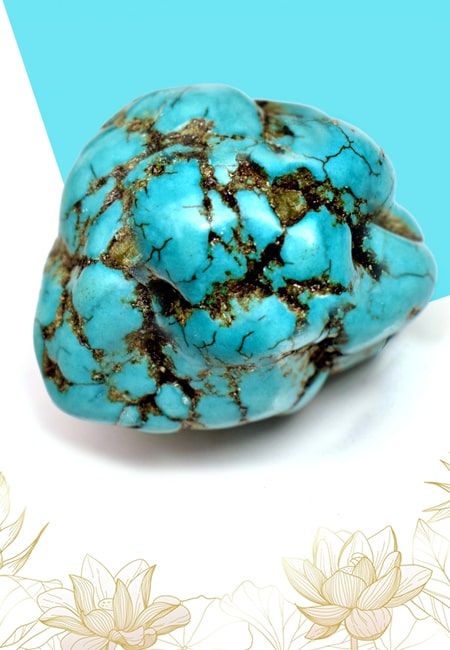
Unveiling the Mysteries of Turquoise Stone: Exploring its Meaning, Healing Properties, Power, Facts, Color, Uses, and More
December 05, 2023 / BY Team DWS
Turquoise, with its captivating blue-green hue, has been adorning jewelry and artifacts for centuries. This striking stone has a rich history, rich symbolism, and a plethora of int ..

Plan a Perfect Valentine's Week with Our Valentine Week List 2026
January 22, 2024 / BY Team DWS
Valentine's Day is undoubtedly the most romantic day of the year, but we believe that one day is just not enough to express your love and make your partner feel special. That's why ..
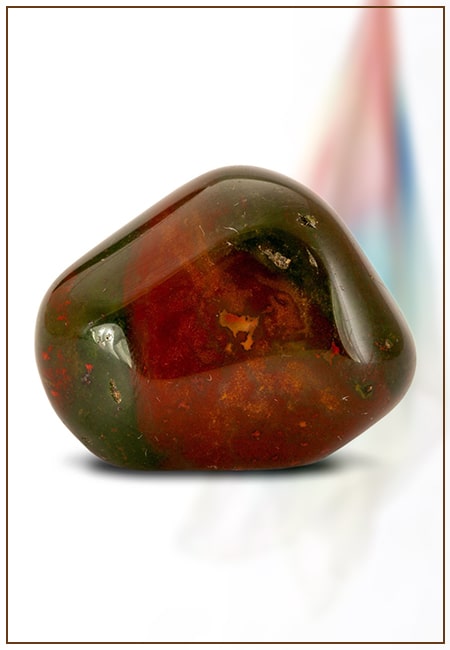
Bloodstone: Unveiling the Meaning, Healing Properties, Facts, Powers, Uses, and More
August 21, 2023 / BY Team DWS
Bloodstone, with its captivating deep green color with specks of red, is a mesmerizing gemstone that has fascinated civilizations for centuries. It possesses unique healing propert ..