


- Written By Team DWS
- Gemstones
- August 26, 2026
Natural versus Laboratory-made? What Should Be the Question for Jewelry Brands
The jewelry industry has been concerned with one question for years now: "Natural or laboratory-grown?"
But when it comes to successful collection development, this may not be as important.
A better question to consider is: "What material is the right material for this collection?" In reality, choosing gemstones doesn't just involve choosing between natural and lab-grown types. It is also a choice with a concrete impact on design, customer expectations, pricing, consistency, production planning and scalability.
For an established luxury jewelry house, the choice of natural gemstones can be an important element of its brand identity. Their uniqueness, formation, presence of inclusions, and rarity can become part of the story of the product.
For a brand that is growing in D2C market, taking advantage of the properties of laboratory-created stones may yield the consistency and repeatability needed to mass-produce jewelry pieces where clients expect that the jewelry they receive is similar to the one they saw online. Thus, neither option is necessarily better than the other.
Making the right choice depends on the goals set by the collection.
At DWS Jewelry, we collaborate with brands merge both natural and lab-formed stones in jewelry collections, which allows us to deal with gemstone selection process from a manufacturing and product development perspective rather than simply posing the question natural vs. lab-grown.
Why Gemstone Selection Should Be Understood as a Product Development Decision
In the process of creating a new jewelry collection, gemstone selection plays a much bigger role than just defining the appearance of finished jewelry.It influences:
- Product position
- Retail pricing
- Design choices
- Availability of similar stones
- Colorful consistency
- Repeatability of production
- Scalability of the collection
- Planning for inventory
- Customer expectations
- Manufacturing timing
- Strategy for gemstone procurement
Let’s imagine that a brand creates a collection of golden rings in a shade of either 10K or 14K that would be sold only online. It will be possible to present a collection of several hundred rings, choose the most popular models to keep producing them and keep the same appearance of the products created during different manufacturing processes. Thus, in this case, it makes sense to think about how consistent the gemstones are.
Now let’s imagine another example of a jewelry collection based on an exclusive collection of gemstones.
In this case, inconsistencies may not be a problem.
On the contrary, they may contribute to the attractiveness of the collection. Each gemstone will differ in color, inclusions, and patterns, giving the facility the opportunity to tell its rare stories.
In this case, the marketing of each collection will be different. Therefore, it is important to consider developing a collection strategy in the first place insteadFor brands associated with luxury, craft, rarity, and exclusivity, natural gemstones can thus play a significant part in the story of product.
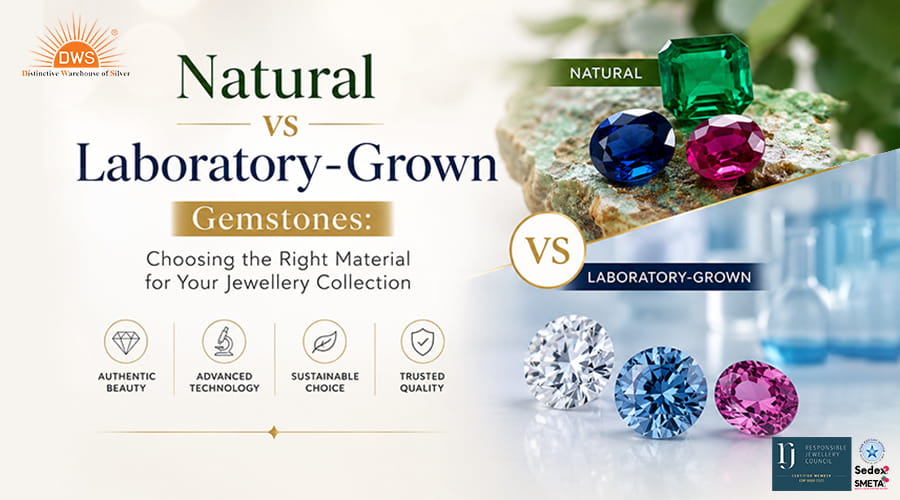
Natural gemstones are particularly advantageous in:
Creating exclusive jewelry - The natural stone is not only a detail of the piece, but also a unique gem that cannot be reproduced in an identical manner.
Luxury collections - For luxury brands, it is especially valuable to use natural stones when their uniqueness serves the purpose of creating value.
Artisan-like jewellery - Collections that are based on organic curves and patterns can use the inconvenience of natural stones to its advantage.
Limited editions - If a brand has the intention to produce limited volumes only, natural gemstones will reinforce the idea of exclusivity they are pursuing.
However, at the same time, natural gemstones require brands to think about a lot of things related to sourcing, availability, matching, and production planning.
On the other hand, laboratory-grown gemstones are made through controlled technological processes, instead of geological processes. One of the main advantages for a jewelry brand is the possibility to duplicate the product.
In fact, when creating a collection that needs to be reproduced with consistently, being able to control the properties of gemstones makes the processes of product design and production easier. It is particularly true for companies having direct contact with customers without distributors.
Just think about someone who purchases online and sees a ring with beautiful blue stone in it. He/she expects the product he/she receives to look almost the same as the one he/she saw on the web. Therefore, if a company wants to create a scalable collection, it is important to consider consistency of stones to be used.
Different Collections Can Use Laboratory-Grown Gemstones
Lab-grown gemstones can be preferable for collections aimed at:
- Homogeneous characteristics
- Constantly replicable manufacturing
- Availability for various volumes
- Pre-defined specifications.
- Good sourcing expectations
- Good competitive product strategies
Nonetheless, this doesn't imply that laboratory-grown gemstones are suitable for every collection. They may serve as efficient development tools when projects have goals such as uniformity and availability.
________________________________________
Natural Gemstones and Laboratory-Grown Gemstones Can Have the Same Essential Characteristics
One of the most crucial aspects for jewelry companies to realize is that the term “natural versus laboratory-grown” does not exhaust the topic. In some cases, a laboratory-grown gem has a similar composition and structure to its natural equivalent.
For example:
Diamonds - Both diamonds are made of the same material and substance but differ in their formation. Natural diamonds were created in geological processes in the Earth crust while lab-made diamonds determine their natural characteristics.
Emeralds - Natural emeralds and lab-made emeralds are two unique representatives of the same beryl mineral class. Only their origin varies.
Rubies and Sapphires - Both ruby and sapphire belong to corundum.Their chemical formula is aluminum oxide with simply the presence of other compounds differing the colors. Lab-grown gemstones have similar qualities of corundum, yet they are produced in a laboratory. That’s why brands should go beyond natural vs laboratory-grown distinction for goods.The next important question is this:What is required of the collection from the gemstone?
________________________________________
Character vs Consistency
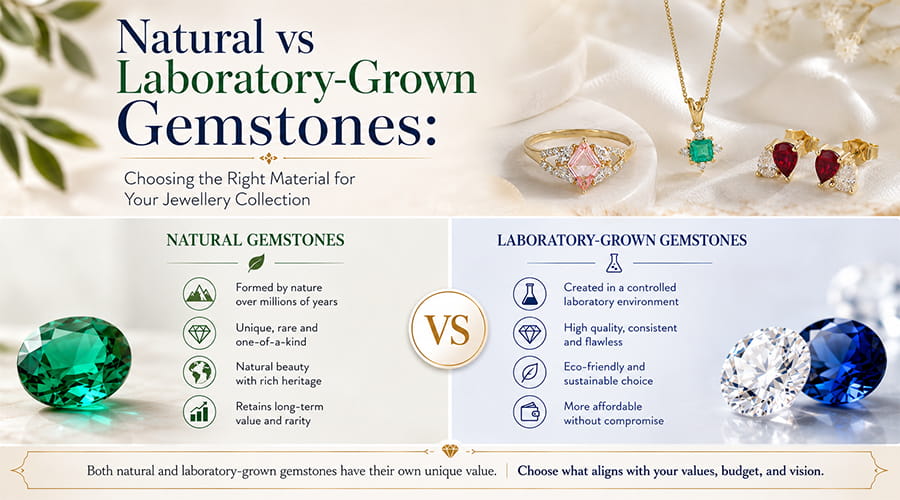
One main area in which the brands will differ when comparing natural gemstones to labs-grown gemstones is the degree of individuality vs consistency. Natural gemstones, on the other hand, can be unpredictable.
Two stones of the same type and approximate size can vary. They might differ in their appearance, inclusions, patterns, and purity. Some jewelry brands will find this attractive in a certain collection.
Laboratory-produced gemstones allow for some degree of control over the properties of the gem. Brand creation that has a regular SKU would help potential customers better adopt products offered.
Simply put Natural gemstone strategy is:“Every stone has a story.”
Laboratory-grown gemstone strategy is:“Every batch of the product can be made according to some standard premise.”
Neither strategy is better than the other. They both serve different purposes.
 ________________________________________
How the brands from D2C industry come up with an idea what type of stone to select for its collection
D2C jewelry brands have a different business model compared to the regular jewelry brands.
Customers are likely to find out about specific products through:
- Brand website
- Content of influencers
- Paid advertising
- Online shops
Thus, product image is quite significant.
The customer sees the photo of a ring on the website and already imagines the appearance of the ring in terms of:
- Color
- Shape
- Size
- Proportion
- Appearance of the stone
- Finish of the metal
In case if the brand is about to create an identical SKU, it becomes essential to be compliant.This is where labs-grown gemstones become useful for some of the collections.On the contrary, D2C brands can also successfully formulate their brand concept using natural gemstones.The most important thing is to communicate the promise of the product clearly.
In case the collection includes natural variations, the brand should communicate that to the customer as well. In case if visual compliance is important in the product, sourcing should ensure compliance.
Finding the Correct Gem Stones for 10K and 14K Gold jewellery
The trend of the easily available fine jewellery opens up many doors to D2C brands dealing with 10K and 14K gold collections. Such collections can be found somewhere between fine jewellery, casual, fashion, self-expressing, affordable lines. In case of such collections, brands should find a proper balance between design appeal and commercial practicality. Collection implies producing of hundreds and thousands of items during its lifecycle.
Thus, the sourcing of gems should fit with the expected amount of production being needed. Lab-created gemstones can be used whenever exact characteristics and consistent production is necessary. Natural gems might be particularly appealing in the case of the brand that strives to portray rarity or uniqueness. Thus, it is important to make the decision about the type of gem used at the level of SKU and collection rather than consistency in the brand.
________________________________________
Benefits of Hybrid Solutions
Jewellery brands do not have to choose any one method for the entire product. Commodity gemstones give an extensive scope for a brand to the new market segments.
For instance, the company must have:
Value Basic - Lab-created gemstones for most prominent, top-selling items. There are four types of jewelry you can always add to the list of gemstones for your brand.
Signature Collection - Natural gemstones are used for producing elegant designs.
Limited Editions - Only selected natural gemstones are used in small batch production.
Entry-Level Fine Jewellery - Laboratory-grown gemstones are selected to cut costs without sacrificing the value for fine jewelry products.
High Jewellery - Unique natural gemstones are the basis of design which is characterized by rarity and uniqueness.
Gemstone policy allows the brand to ensure a more flexible product matrix without necessarily following one stone policy.
________________________________________
Gemstone Strategy and Manufacturing
The decision about the types of gemstones should be discussed with the manufacturer prior to finalization of the collection.
The manufacturer should understand:
- Type of stone
- Source of stone
- Size
- Shape
- Cut
- Colour specifications
- Clarity specifications
- Quantity
- Style of stone setting
- Metal material
- Expected volume of production
- Anticipated frequency of orders
This aspect is crucial for designing custom jewelry. Although the design can be perfect on paper, the manufacturer has to understand if the design can be manufactured in practice. For instance, a brand may want to purchase large stone and produce consistent items bases on that.
The important question here is whether stones can be sourced repeatedly and beat the supply requirement. This is why it is important to cooperate at an early stage of the project with the brand, stone supplier, CAD team and manufacturer.
_______________________________________
Why Scalability Matters before Kicking Off Your Project
One of the common mistakes in jewellery development is thinking only about the first collection release.It might be necessary to create various iterations of a successful piece of jewellery. The first order can consist of 50 pieces.
Then it can be 100. Soon it may grow to 500 pieces. And one particular SKU can become a top seller of the brand. If the sourcing strategy does not allow for this growth, the brand will have to deal with consistent problems while maintaining product specifications.
Therefore, scalability should be taken into account in the very beginning.
The following questions should be discussed:
1. Will the sourcing of gems be stable?
2. Will the sizes comply with the required ones?
3. Will the colour specifications be repeated?
4. Will a supply of products be increased?
5. Will design be produced successfully through different manufacturing processes?
6. Will the price be affordable?
7. Will the product’s promise be kept over the years when the brand develops?
All these questions can be even more important than the question about whether your gemstone is natural or created in the lab.
________________________________________
Budget matters – but it should not be the only priority.
Price is, of course, one of the significant points when developing a piece of jewellery. However, choosing the stones according to the least expensive ones will open the door to other problems.
The choice of the appropriate material is based on the following factors: Price + Design + Customer Expectations + Availability + Consistency + Scalability. For instance, a company can choose a stone because of its suitability for a specific retail price.
Otherwise, if your supplier has no consistency, it will be impossible to create a proper collection. In the end, the result should be a product that has both proper branding and commercial appeal.
________________________________________
Designing for the Customer Instead of the Rhetoric
The debate around natural vs synthetic gemstones can get quite heated in the jewellery sector. Nevertheless, your clients are not interested in the debate.
Some people want:
- A natural product.
- Rarity.
- Individuality.
- Heritage.
- Traditional craftsmanship.
Other clients may be more interested in:
- Consistency.
- Design.
- Affordability.
- Modern production.
- Predictable look.
- Responsible purchasing.
In order to be successful, a jewellery brand must identify the target customer. So the question should be: What do your customers value the most? Once you answer that, the choice of gemstones becomes easier.
________________________________________
How jewellery brands can create an effective strategy for product development
When designing the new collections, brands can follow an easy framework.
Step 1: Identify the Customer - Who is the collection designed for? Is your customer looking for casual, gift, luxury, or investment jewelry?
Step 2: Identify the Cost - What could be the price of your product and what metals, stones, production, packaging, and markups you can use?
Step 3: Identify Your Collection - Should the concept be based on rarity and uniqueness or on consistency and repeated patterns?
Step 4: Identify Your Stone Policy - Based on the answers on the previous steps, the idea of using natural, synthetic or a combination of both could be established.
Step 5: Analyze Manufacturing Feasibility - Collaborate with your suppliers to check on stone availability, fixtures, dimension, metal requirements, and ability to manufacture in reality.
Step 6: Plan Ahead Reorders - Make not just your initial order. Think of what happens when the item really becomes popular.
Step 7: Communicate Clearly - Make sure that your website and product descriptions accurately describe the gemstone and its characteristics so purchasers know what they are buying.
________________________________________
The Future of Jewelry is in Diversity
The jewelry trade is growing rapidly. Today, manufacturers are able to utilize many types of materials, methods of manufacturing, types of gemstones, and product construction models than before.
It allows for an opportunity. Rather than looking at processed and grown gemstones as rivalling markets, manufacturers may think of them as separate instruments and utilize them in varying ways.
Creating a distinct piece of jewelry may require the specific properties of natural stones.The creation of a product sold by a D2C model may require some type of stoning able to be repeated.
Brands operating in different markets may develop a piece combining both types.The optimum way to address the problem is not to make a choice between the two.
One should examine their initial reasons for making such a decision.
 ________________________________________
Initiating Your Jewelry Collection with the Right Manufacturer
DWS Jewelry thinks of jewelry creation as something far more than merely producing the jewelry. The manufacturer is part of the supply chain. From making a choice regarding gemstones and designing the product, there are many stages of the process that can affect the final product.
We produce jewelry brands from using natural and grown gemstones, aiding in selection process by looking at the choice made from different perspectives. A jewelry brand has one key goal - Create jewelry that has meaning.
________________________________________
Final thoughts: Don’t manufacture while you are still thinking.
Successful brands pay much attention to the question of whether natural or lab-made stones are better. They ask what is better for their product. This change in viewpoint makes a considerable difference.
Natural stones are always connected with special features of rarity and natural origin. Artificial stones help achieve higher consistency of required characteristics across all items.
In many cases, the finest strategy will be to utilize both types of stones for one and the same piece. In the end, there is more to producing jewelry than just the type of stone used.
Jewelry is also about design, customers, message, positioning, and whatever else goes into creating a piece of jewelry. Great brands do not set out to produce a product. They set out to design an item for their clients.
Popular on Blogs
Black Tourmaline: Meaning, Healing Properties, Fascinating Facts, Powerful Attributes, Versatile Uses, and Beyond
September 05, 2023 / BY Team DWS
Black Tourmaline, also known as Schorl, is a highly revered crystal with incredible metaphysical properties. It derives its name from the Dutch word "turamali," meaning "stone with ..
Carnelian Stone: Meaning, Healing Properties, Power, Facts, Color, Uses and More
December 26, 2023 / BY Team DWS
Carnelian is a vibrant and captivating gemstone that holds a plethora of meanings, healing properties, and powers. Its warm and fiery energy makes it a popular choice among crystal ..
Citrine: Exploring its Meaning, Healing Properties, Fascinating Facts, Powers, Versatile Uses, and Much More
November 18, 2023 / BY Team DWS
Citrine, with its warm golden hues, has captured the attention and imagination of people for centuries. This beautiful gemstone, commonly associated with wealth and prosperity, hol ..
Black Onyx: Unveiling the Meaning, Healing Properties, Fascinating Facts, Powerful Attributes, Versatile Uses, and Beyond
July 25, 2023 / BY Team DWS
Black Onyx, a striking gemstone admired for its deep black hue and elegant appearance, has captivated people for centuries. In this comprehensive guide, we will delve into the mean ..
The History Behind The Popularity of Red Agate
December 23, 2022 / BY Team DWS
An Agate is a type of magma rock that takes many years till it is washed out naturally into the water. And that is the reason this stone has elements of water. This beautiful stone ..
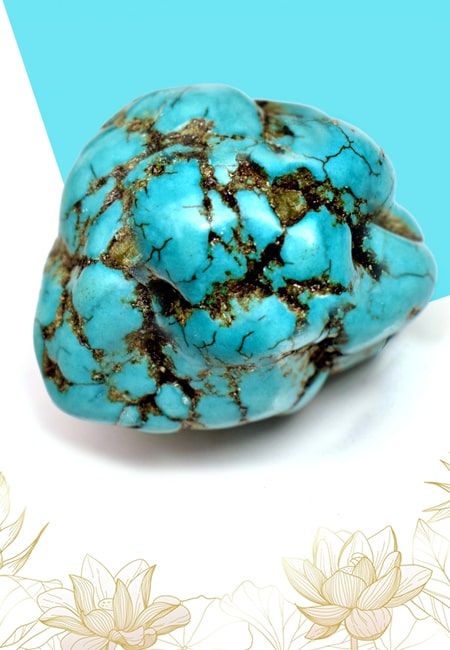
Unveiling the Mysteries of Turquoise Stone: Exploring its Meaning, Healing Properties, Power, Facts, Color, Uses, and More
December 05, 2023 / BY Team DWS
Turquoise, with its captivating blue-green hue, has been adorning jewelry and artifacts for centuries. This striking stone has a rich history, rich symbolism, and a plethora of int ..
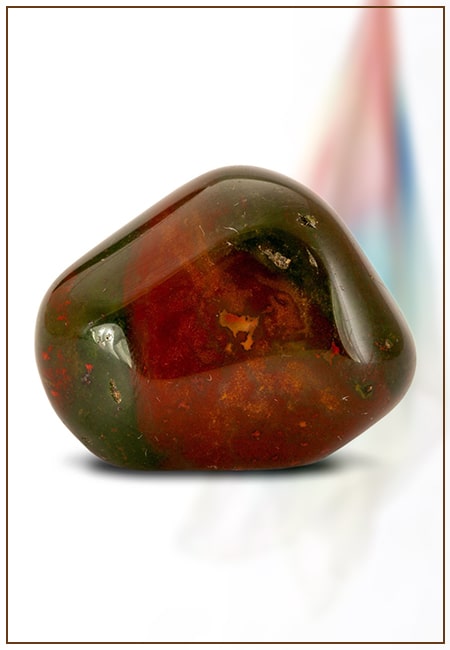
Bloodstone: Unveiling the Meaning, Healing Properties, Facts, Powers, Uses, and More
August 21, 2023 / BY Team DWS
Bloodstone, with its captivating deep green color with specks of red, is a mesmerizing gemstone that has fascinated civilizations for centuries. It possesses unique healing propert ..
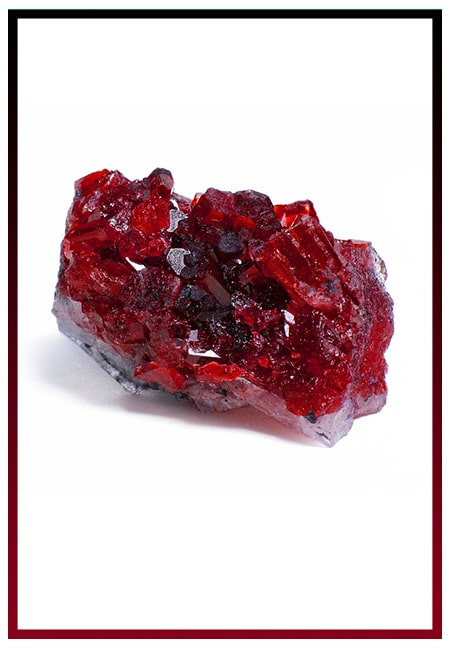
Garnet Stone Meaning, Healing Properties, Power, Facts, Color, Uses and More
December 02, 2023 / BY Team DWS
Garnet, a beautiful gemstone found in various colors, holds immense value both in terms of aesthetics and healing properties. This article explores the meaning, healing properties, ..